Fine-tuning a 1.7B model at 3.2 GB VRAM — building FineTune Studio
Originally published at https://pranjulrathour.scult.in/blog/finetune-studio-qlora-on-a-budget. That copy is the canonical version and gets updates first.
FineTune Studio exists because every fine-tuning tutorial I found assumed a rented A100 and a notebook full of half-explained flags. I wanted something a student could run: upload a dataset, validate it, launch a real QLoRA job, watch the loss stream live, then see — not assume — whether the fine-tuned model actually improved.
The numbers that matter
- 17 backend endpoints, 107 / 107 tests passing.
- Base model Qwen3-1.7B, peak VRAM ~3.2 GB.
- 3 inference paths: local, vLLM, or a Hugging Face Space — pick per deployment.
- 7 frontend pages: Dashboard, Datasets, Training, Live Logs, Evaluation, Experiments, Settings.
Dataset validation before a single GPU cycle
Most fine-tuning failures I've seen aren't hyperparameter problems, they're dataset problems — malformed JSON, duplicate examples, a prompt template mismatch. FineTune Studio validates the dataset on upload and reports the actual issue, not a stack trace three steps into training.
Live telemetry, not a log file to tail
Training streams loss, learning rate and throughput live over the same connection the frontend already holds — so a run's progress is a graph, not a terminal you keep alt-tabbing to.
The comparison is the whole point
If you can't show the before and after, you didn't fine-tune — you spent GPU hours. The Evaluation page runs the same prompts against the base model and the tuned model side by side. That comparison, more than the loss curve, is what tells you whether the run was worth it.
What I'd tell a student starting this
Don't buy a GPU first. Learn on the free tier and on small models — the memory limit teaches you more about your dependencies than any tutorial does. A 3B model with your own dataset and an honest eval beats a huge model behind an API you only rent for a demo.
Code and the full architecture: github.com/Pranjulrathour/FINETUNESTUDIO.
 | Pranjul Rathour GenAI engineer, Kanpur · 3x first-prize hackathon winner · campus mentor I ship production RAG pipelines, fine-tune LLMs and build agentic AI products end to end. I lead engineering at SCULT INDIA for a 14-member team and have mentored 200+ students through TechVerse Enclave. Open to: GenAI roles, hackathon judging, mentorship sessions and guest talks at colleges. Email: pranjulrathour41@gmail.com |
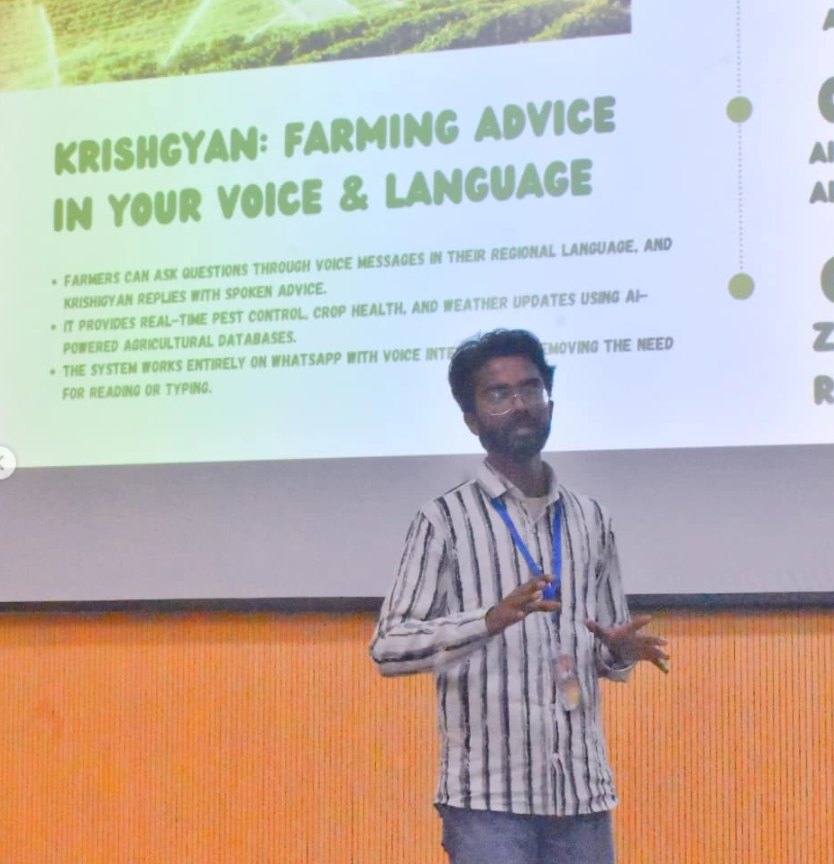 Presenting KrishGyan, farming advice in your voice and language |  At an Integral Startup Foundation hackathon |  Pitching at CSJMU, Kanpur |


Comments
Post a Comment